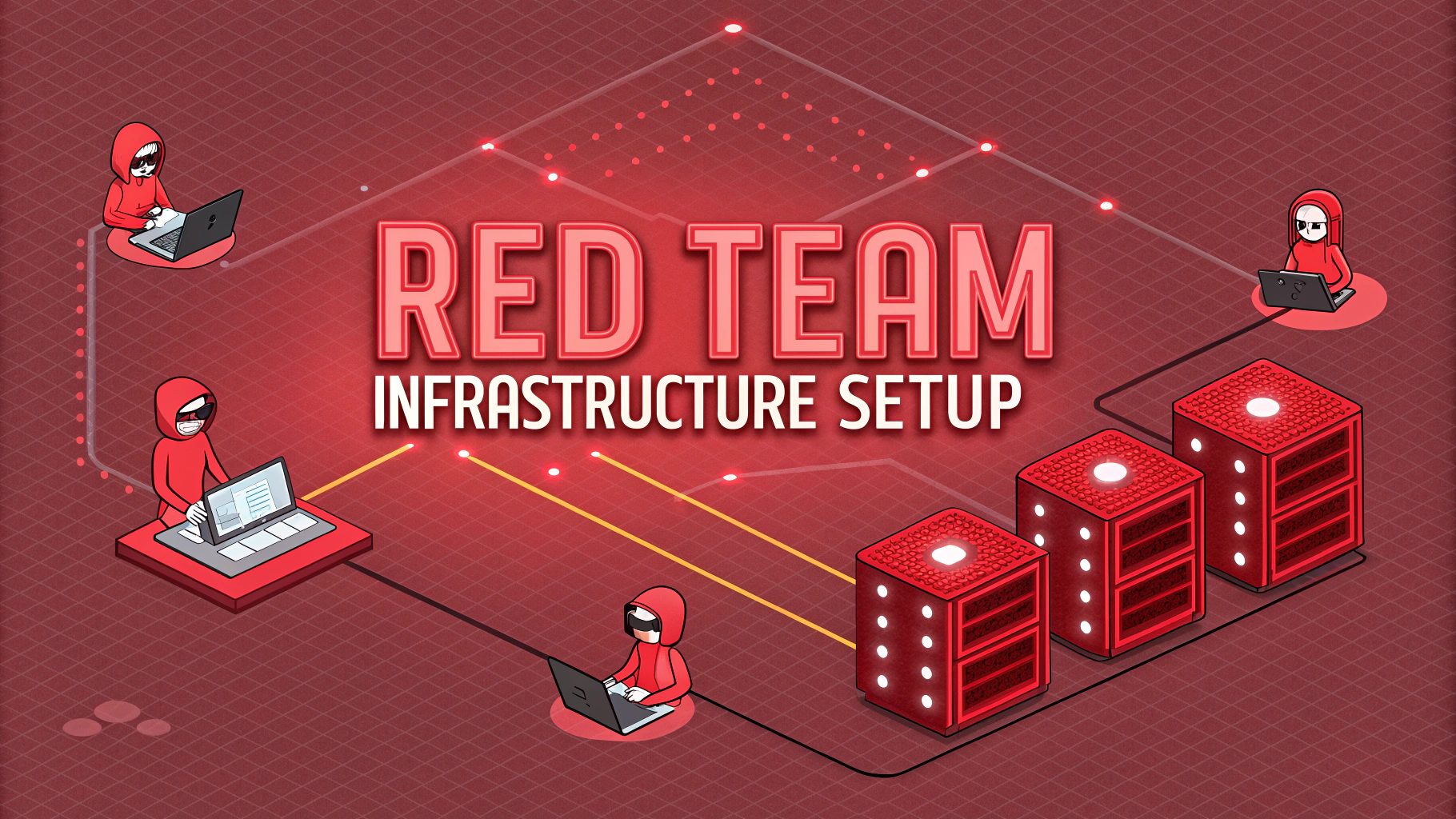
Red Team Infrastructure Setup
Setting up secure and undetectable infrastructure is fundamental for successful red team operations and penetration testing engagements. A well-design
Red Team Infrastructure Setup
Setting up secure and undetectable infrastructure is fundamental for successful red team operations and penetration testing engagements.
A well-designed red team infrastructure helps maintain operational security while providing reliable command and control capabilities for assessment activities.
This guide covers essential infrastructure components, operational security considerations, and deployment strategies for red team operations.
Infrastructure Components
- Long-haul redirectors (front-facing servers)
- Short-haul redirectors (operation-specific servers)
- Command and Control (C2) servers
- Payload hosting servers
- Operational support systems
Server Requirements
Each server component requires specific configurations and security controls:
Component
Requirements
Long-haul redirectors
High uptime, clean IP reputation, minimal services
Short-haul redirectors
Dynamic IPs, region-specific hosting
C2 servers
Protected management interfaces, encrypted storage
Domain Configuration
- Register domains through privacy-focused registrars
- Use separate domains for each operation
- Implement realistic-looking DNS records
- Configure SSL certificates properly
OPSEC Considerations
- Use separate VPNs for management access
- Implement proper firewall rules and access controls
- Monitor for scanning and detection attempts
- Maintain separate infrastructure for each client engagement
Recommended Tools
- Domain Fronting: Azure CDN, CloudFront
- C2 Frameworks: Cobalt Strike, Covenant, Empire
- Traffic Redirectors: Apache, Nginx, Socat
- VPN Services: Mullvad, ProtonVPN
Infrastructure Deployment Steps
- Set up VPN and management infrastructure
- Deploy long-haul redirectors
- Configure C2 servers with proper security controls
- Set up short-haul redirectors for specific operations
- Test infrastructure components independently
- Verify OPSEC controls and monitoring
Best Practices for Maintenance
- Rotate infrastructure components regularly
- Monitor for indicators of detection
- Maintain detailed documentation of configurations
- Implement automated backup procedures
- Regular security updates and patches
Taking Your Setup Further
Advanced infrastructure setups can incorporate additional security measures:
- Implement traffic categorization systems
- Deploy decoy servers and honeypots
- Use cloud-based redirectors
- Implement automated infrastructure deployment
Resources and Support
For additional guidance and support:
- SANS Penetration Testing Resources
- Offensive Security Training
- Red Team Infrastructure GitHub repositories
- Professional red team communities and forums
Advanced Deployment Scenarios
Red team infrastructure can be enhanced with advanced deployment scenarios to improve resilience and evasion capabilities:
- Multi-region deployments for global operations
- Containerized infrastructure components
- Auto-scaling C2 frameworks
- Dynamic DNS rotation systems
Incident Response Planning
Infrastructure must include contingency plans for various scenarios:
Detection Response
- Automated infrastructure rotation procedures
- Backup communication channels
- Clean-up protocols for compromised assets
Emergency Procedures
- Quick teardown protocols
- Evidence elimination procedures
- Client notification processes
Compliance and Documentation
Maintain comprehensive documentation for compliance and operational purposes:
- Infrastructure diagrams and network maps
- Configuration management databases
- Change control procedures
- Incident response playbooks
Future-Proofing Your Infrastructure
Consider emerging trends and technologies when building red team infrastructure:
- Zero-trust architecture integration
- Cloud-native deployment options
- AI-powered detection evasion
- Quantum-safe encryption preparation
Building Resilient Red Team Operations
Success in red team operations depends on well-architected, secure, and maintainable infrastructure. Regular testing, updates, and adherence to security best practices ensure long-term operational effectiveness while maintaining strict operational security requirements.
- Continuously evaluate and improve infrastructure components
- Stay informed about latest detection methods
- Maintain relationships with infrastructure providers
- Keep team members trained on new technologies
FAQs
- What is Red Team Infrastructure and why is it important?
Red Team Infrastructure refers to the servers, systems, and networks set up to conduct authorized offensive security operations. It’s crucial for maintaining operational security, hiding attack origins, and providing realistic attack simulation environments. - What are the essential components of Red Team Infrastructure?
Essential components include redirectors (front-facing servers), command and control (C2) servers, staging servers, payload hosting, logging systems, and VPN endpoints for secure team communications. - How should domains be set up for Red Team operations?
Domains should be carefully selected to appear legitimate, aged properly, use appropriate categorization, and be registered through privacy-focused registrars. Multiple domains should be used with different purposes (phishing, C2, payload hosting). - What security measures are crucial for protecting Red Team Infrastructure?
Critical security measures include IP whitelisting, multi-factor authentication, encrypted communications, proper firewall configurations, regular security updates, and robust logging mechanisms. - What are redirectors and why are they necessary?
Redirectors are intermediate servers that forward traffic between attack infrastructure and targets. They help hide the true C2 infrastructure, provide operational resilience, and allow quick infrastructure changes if compromised. - How should Command and Control (C2) servers be configured?
C2 servers should be hardened, run minimal services, implement strict access controls, use encrypted communications, and be configured with proper logging and monitoring capabilities. - What role does cloud infrastructure play in Red Team operations?
Cloud infrastructure provides flexibility, scalability, and geographic distribution. It allows quick deployment of servers, easy resource management, and can help blend in with legitimate business traffic. - What are common mistakes in Red Team Infrastructure setup?
Common mistakes include using default configurations, failing to implement proper access controls, not implementing proper logging, using predictable naming conventions, and insufficient segmentation between different infrastructure components. - How should traffic be managed to avoid detection?
Traffic should be carefully profiled to match legitimate business traffic, use appropriate protocols, implement proper timing controls, and utilize traffic shaping to avoid detection by security monitoring systems. - What backup measures should be in place for Red Team Infrastructure?
Backup measures should include redundant C2 channels, alternative communication methods, backup servers in different geographic locations, and documented recovery procedures for compromised infrastructure.

Author: Editor

April 11, 2025
Related Posts
Tool Documentation Standards
documentation standards
Documentation standards ensure consistency, clarity, and effectiveness when recording findings during penetration testing engagements. Proper documentation helps security teams track vulnerabilities, communicate issues to stakeholders, and maintain an audit trail ... Read more
Testing Tool Integration
tool integration
Testing tool integration is a critical aspect of cybersecurity assessment that combines various security testing tools to create a more robust and comprehensive penetration testing workflow. Security professionals need efficient ... Read more
Automation Framework Design

automation framework
An automation framework streamlines and standardizes penetration testing processes, making security assessments more efficient and repeatable. Properly designed frameworks reduce manual effort while maintaining testing quality and consistency across different ... Read more
Exploitation Tool Development
tool development
Penetration testing tools require careful development to effectively identify security vulnerabilities in systems and networks. Security professionals need specialized exploitation tools that can safely simulate real-world attacks without causing damage. ... Read more
Security Tool Architecture
tool architecture
Security tool architecture forms the backbone of effective penetration testing, enabling security professionals to systematically probe systems for vulnerabilities. A well-structured security testing toolkit combines reconnaissance tools, vulnerability scanners, exploitation ... Read more
Build Server Security
build security
Security testing of build servers protects the foundation of software development and deployment processes from potential threats and vulnerabilities. Build servers handle sensitive data, access credentials, and control deployment pipelines, ... Read more
Secret Management

secrets management
Secret management stands as a cornerstone of cybersecurity, particularly during penetration testing operations where handling sensitive data requires meticulous care and precision. Penetration testers must safeguard various types of secrets ... Read more
Deployment Security
deployment security
Penetration testing during deployment phases helps organizations identify security vulnerabilities before applications go live. Security teams use automated and manual testing methods to simulate real-world attacks against newly deployed systems ... Read more