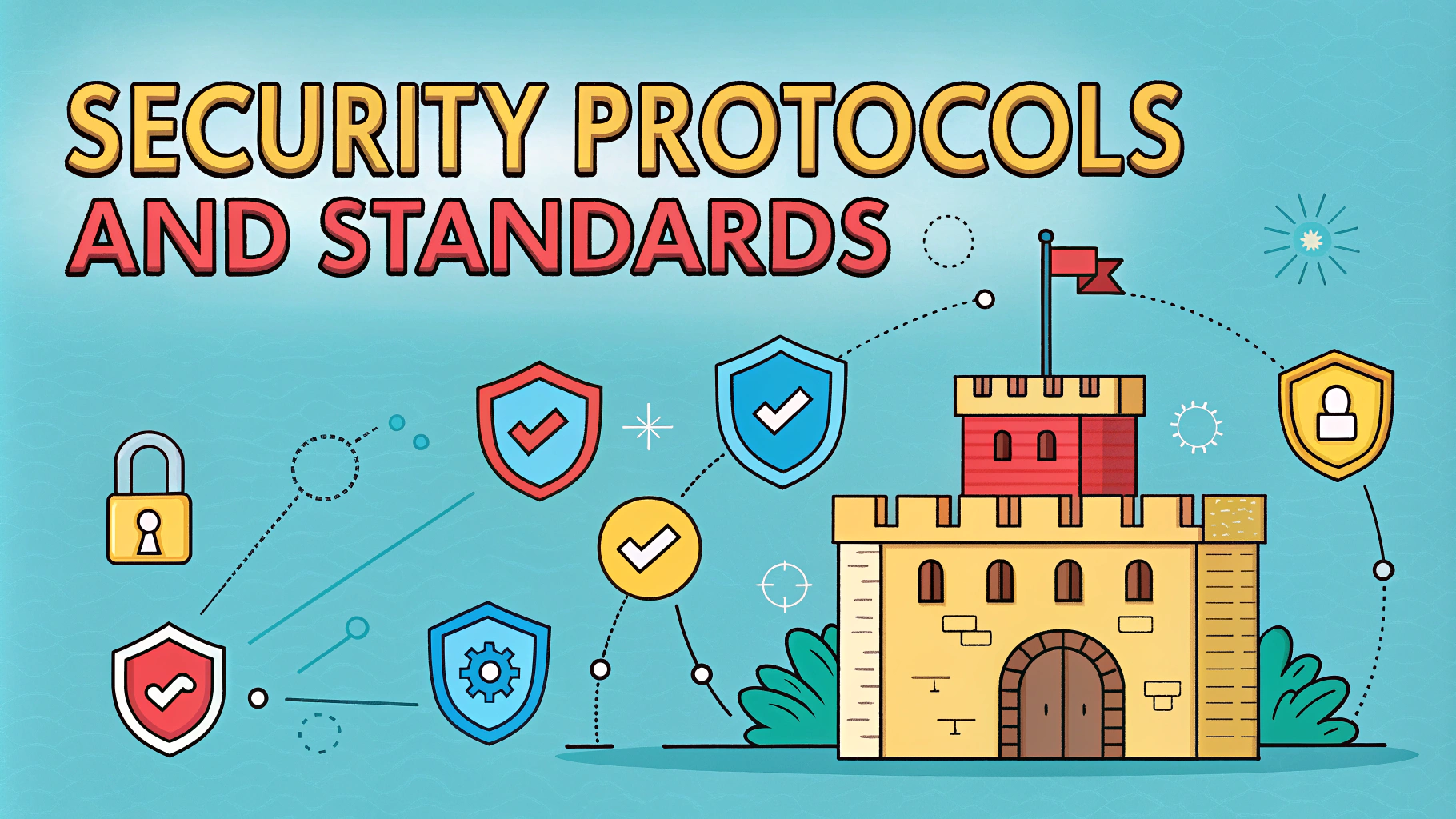
Security Protocols and Standards
Security protocols and standards form the foundation of any effective penetration testing strategy. Common Security Protocols SSL/TLS - Encrypts data
Security Protocols and Standards

Security protocols and standards form the foundation of any effective penetration testing strategy.
Common Security Protocols
- SSL/TLS – Encrypts data in transit between client and server
- SSH – Secure remote system administration
- IPSec – Network layer security for IP packets
- HTTPS – Secure web browsing protocol
Key Security Standards
- ISO 27001 – Information security management systems
- PCI DSS – Payment card industry security standard
- NIST SP 800-53 – Security controls framework
- OWASP Top 10 – Web application security risks
Testing Protocol Security
Each security protocol requires specific testing methods and tools.
Protocol
Testing Tool
Primary Use
SSL/TLS
SSLyze, TestSSL.sh
Certificate validation, cipher analysis
SSH
Nmap, SSH-Audit
Version detection, configuration testing
IPSec
IKEProbe, ike-scan
VPN testing, encryption verification
Quick Testing Checklist
- ✓ Verify protocol versions and updates
- ✓ Check for known vulnerabilities
- ✓ Test encryption strength
- ✓ Analyze authentication mechanisms
- ✓ Review access controls
Common Testing Mistakes
- Skipping protocol version checks
- Ignoring deprecated ciphers
- Missing certificate validation
- Overlooking default configurations
For detailed protocol specifications and updates, check IETF Standards.
Report security protocol vulnerabilities to US-CERT or relevant national CERT teams.
Recommended Tools
- Wireshark – Protocol analysis
- Burp Suite – Web protocol testing
- Nmap – Network protocol scanning
- Metasploit – Exploitation testing
Pro Tip: Always maintain separate testing environments for protocol security assessments.
Documentation Requirements
- Protocol versions tested
- Tools and methods used
- Findings and vulnerabilities
- Remediation recommendations
- Test environment details
Testing Environment Setup
Proper testing environments are crucial for accurate protocol security assessment.
- Isolated network segments
- Virtual machines for different scenarios
- Traffic monitoring points
- Logging infrastructure
Advanced Testing Techniques
Protocol Fuzzing
- Automated input variation
- Boundary testing
- Error handling verification
Man-in-the-Middle Testing
- Protocol downgrade attacks
- Certificate spoofing
- Traffic interception analysis
Compliance Considerations
Standard
Protocol Requirements
Testing Frequency
PCI DSS
TLS 1.2 or higher
Quarterly
HIPAA
Encryption in transit
Annual
GDPR
State-of-art encryption
Regular assessment
Future Considerations
- Quantum cryptography impacts
- Zero-trust protocol implementation
- AI-based protocol analysis
- Automated compliance testing
Conclusion
Effective protocol security testing requires a comprehensive approach combining proper tools, methodologies, and documentation. Regular updates to testing procedures and continuous monitoring of new vulnerabilities ensure maintained security posture. Organizations must balance compliance requirements with practical security measures while preparing for emerging threats and technologies.
Note: Keep testing procedures updated with evolving security standards and new protocol versions.
FAQs
- What is the difference between SAST and DAST in security testing?
Static Application Security Testing (SAST) analyzes source code without executing the application, while Dynamic Application Security Testing (DAST) tests running applications by simulating attacks from the outside. - What is the OWASP Top 10, and why is it important in penetration testing?
The OWASP Top 10 is a regularly updated list of the most critical web application security risks. It serves as a standard awareness document for developers and security professionals, guiding penetration testing priorities and methodologies. - What are the main phases of a penetration test?
The main phases are Planning and Reconnaissance, Scanning, Vulnerability Assessment, Exploitation, Post-Exploitation, and Reporting. Each phase follows a structured approach to identify and document security vulnerabilities. - How does compliance with ISO 27001 relate to penetration testing?
ISO 27001 requires regular security assessments, including penetration testing, as part of its Information Security Management System (ISMS) framework to maintain certification and ensure continuous security improvement. - What is the difference between black box, white box, and grey box testing?
Black box testing involves no prior knowledge of the system, white box testing provides complete system information, and grey box testing offers partial system knowledge to the tester. - How frequently should organizations conduct penetration tests?
Organizations should conduct penetration tests at least annually, after significant infrastructure changes, following major application updates, or as required by compliance standards like PCI DSS. - What is the significance of the CVE database in penetration testing?
The Common Vulnerabilities and Exposures (CVE) database provides standardized identifiers for known security vulnerabilities, helping penetration testers identify and verify potential security issues. - What role does the NIST Cybersecurity Framework play in penetration testing?
The NIST Cybersecurity Framework provides guidelines for security testing, including penetration testing, as part of its Identify, Protect, Detect, Respond, and Recover core functions. - What are the key differences between vulnerability scanning and penetration testing?
Vulnerability scanning is automated and identifies known vulnerabilities, while penetration testing involves manual testing, exploitation attempts, and simulates real-world attack scenarios. - How does PCI DSS compliance impact penetration testing requirements?
PCI DSS requires annual penetration testing and after significant infrastructure or application changes, specifically focusing on cardholder data environment security.

Author: Editor

December 18, 2024
Related Posts
Tool Documentation Standards
documentation standards
Documentation standards ensure consistency, clarity, and effectiveness when recording findings during penetration testing engagements. Proper documentation helps security teams track vulnerabilities, communicate issues to stakeholders, and maintain an audit trail ... Read more
Testing Tool Integration
tool integration
Testing tool integration is a critical aspect of cybersecurity assessment that combines various security testing tools to create a more robust and comprehensive penetration testing workflow. Security professionals need efficient ... Read more
Automation Framework Design

automation framework
An automation framework streamlines and standardizes penetration testing processes, making security assessments more efficient and repeatable. Properly designed frameworks reduce manual effort while maintaining testing quality and consistency across different ... Read more
Exploitation Tool Development

tool development
Penetration testing tools require careful development to effectively identify security vulnerabilities in systems and networks. Security professionals need specialized exploitation tools that can safely simulate real-world attacks without causing damage. ... Read more
Security Tool Architecture
tool architecture
Security tool architecture forms the backbone of effective penetration testing, enabling security professionals to systematically probe systems for vulnerabilities. A well-structured security testing toolkit combines reconnaissance tools, vulnerability scanners, exploitation ... Read more
Build Server Security

build security
Security testing of build servers protects the foundation of software development and deployment processes from potential threats and vulnerabilities. Build servers handle sensitive data, access credentials, and control deployment pipelines, ... Read more
Secret Management

secrets management
Secret management stands as a cornerstone of cybersecurity, particularly during penetration testing operations where handling sensitive data requires meticulous care and precision. Penetration testers must safeguard various types of secrets ... Read more
Deployment Security
deployment security
Penetration testing during deployment phases helps organizations identify security vulnerabilities before applications go live. Security teams use automated and manual testing methods to simulate real-world attacks against newly deployed systems ... Read more