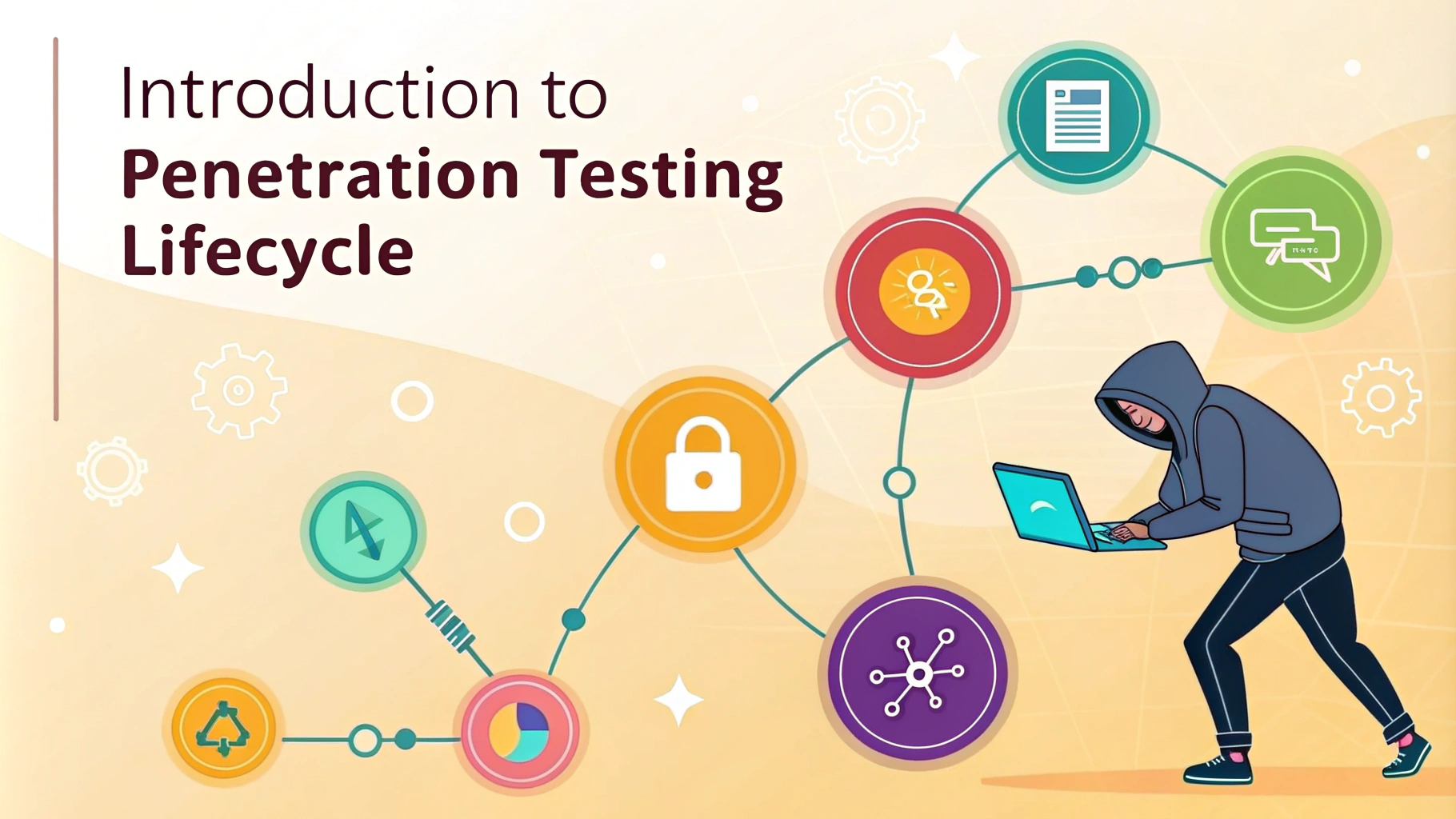
Introduction to Penetration Testing Lifecycle
The penetration testing lifecycle follows a structured approach that helps security professionals systematically evaluate and improve an organization&
Introduction to Penetration Testing Lifecycle
The penetration testing lifecycle follows a structured approach that helps security professionals systematically evaluate and improve an organization’s security posture.
Overview of Penetration Testing Phases
- Planning & Reconnaissance
- Scanning & Vulnerability Assessment
- Gaining Access
- Maintaining Access
- Analysis & Reporting
1. Planning & Reconnaissance
The first phase involves gathering information about target systems using both passive and active methods.
- Passive techniques: WHOIS lookups, public records
- Active techniques: DNS enumeration, port scanning
- Social engineering research
- Network mapping
2. Scanning & Vulnerability Assessment
This phase identifies potential security weaknesses through automated and manual testing.
- Port scanning using tools like Nmap
- Vulnerability scanning with Nessus or OpenVAS
- Service version identification
- Network traffic analysis
3. Gaining Access
Penetration testers attempt to exploit discovered vulnerabilities to gain system access.
- Exploiting known vulnerabilities
- Password attacks
- Web application testing
- Social engineering attacks
4. Maintaining Access
After gaining access, testers document persistence methods and potential lateral movement.
- Backdoor creation
- Privilege escalation
- Data exfiltration testing
5. Analysis & Reporting
The final phase involves documenting findings and providing actionable recommendations.
- Vulnerability documentation
- Risk assessment
- Remediation steps
- Executive summary
Tools for Each Phase
Phase
Recommended Tools
Reconnaissance
Maltego, Recon-ng, theHarvester
Scanning
Nmap, Nessus, OpenVAS
Exploitation
Metasploit, Burp Suite, SQLmap
Post-Exploitation
Mimikatz, PowerSploit, Empire
Reporting
Dradis, PlexTrac, Faraday
Best Practices
- Document all activities during testing
- Maintain communication with stakeholders
- Follow the agreed-upon scope
- Handle sensitive data securely
- Verify findings to eliminate false positives
For additional resources and training, consider SANS Institute courses (www.sans.org) or Offensive Security certifications (www.offensive-security.com).
Additional Considerations
Legal and Compliance
Penetration testing must comply with legal requirements and industry regulations.
- Written authorization requirements
- Scope boundaries documentation
- Data handling procedures
- Regulatory compliance (GDPR, HIPAA, etc.)
Risk Management
Understanding and managing risks during penetration testing is crucial for success.
- Impact assessment
- Testing environment isolation
- Backup procedures
- Incident response planning
Team Composition
Effective penetration testing requires diverse skill sets and expertise.
- Technical specialists
- Project managers
- Documentation experts
- Quality assurance reviewers
Conclusion
Successful penetration testing requires a methodical approach following the established lifecycle phases. Organizations must:
- Maintain clear documentation throughout the process
- Ensure proper authorization and scope definition
- Use appropriate tools for each phase
- Follow security best practices
- Provide actionable recommendations for improvement
FAQs
- What is the Penetration Testing Lifecycle?
The Penetration Testing Lifecycle is a systematic approach to security testing that includes planning, reconnaissance, scanning, vulnerability assessment, exploitation, post-exploitation, and reporting phases. - How long does a typical penetration test take?
A typical penetration test can take anywhere from one week to several weeks, depending on the scope, complexity of systems, and organizational size. - What’s the difference between black box, white box, and grey box penetration testing?
Black box testing involves no prior knowledge of the target system, white box testing provides complete system information, and grey box testing offers partial knowledge of the target system. - What documentation is required before starting a penetration test?
Required documentation includes scope definition, testing authorization, Rules of Engagement (RoE), non-disclosure agreements (NDAs), and emergency contact information. - What tools are commonly used in penetration testing?
Common tools include Nmap for network scanning, Metasploit for exploitation, Burp Suite for web application testing, Wireshark for packet analysis, and various vulnerability scanners. - How often should organizations conduct penetration tests?
Organizations should conduct penetration tests at least annually, after significant infrastructure changes, or as required by compliance standards like PCI DSS. - What’s the difference between vulnerability scanning and penetration testing?
Vulnerability scanning is an automated process to identify potential vulnerabilities, while penetration testing involves active exploitation and manual testing by security professionals. - What should a penetration testing report include?
A penetration testing report should include an executive summary, methodology, findings with severity ratings, technical details, proof of concepts, and remediation recommendations. - What are the legal considerations for penetration testing?
Legal considerations include obtaining written permission, staying within scope, protecting sensitive data, complying with local laws, and having proper agreements in place. - What skills are required to become a penetration tester?
Required skills include networking knowledge, programming abilities, understanding of operating systems, knowledge of security concepts, analytical thinking, and report writing capabilities.

Author: Editor

December 18, 2024
Related Posts
Tool Documentation Standards
documentation standards
Documentation standards ensure consistency, clarity, and effectiveness when recording findings during penetration testing engagements. Proper documentation helps security teams track vulnerabilities, communicate issues to stakeholders, and maintain an audit trail ... Read more
Testing Tool Integration
tool integration
Testing tool integration is a critical aspect of cybersecurity assessment that combines various security testing tools to create a more robust and comprehensive penetration testing workflow. Security professionals need efficient ... Read more
Automation Framework Design

automation framework
An automation framework streamlines and standardizes penetration testing processes, making security assessments more efficient and repeatable. Properly designed frameworks reduce manual effort while maintaining testing quality and consistency across different ... Read more
Exploitation Tool Development
tool development
Penetration testing tools require careful development to effectively identify security vulnerabilities in systems and networks. Security professionals need specialized exploitation tools that can safely simulate real-world attacks without causing damage. ... Read more
Security Tool Architecture
tool architecture
Security tool architecture forms the backbone of effective penetration testing, enabling security professionals to systematically probe systems for vulnerabilities. A well-structured security testing toolkit combines reconnaissance tools, vulnerability scanners, exploitation ... Read more
Build Server Security

build security
Security testing of build servers protects the foundation of software development and deployment processes from potential threats and vulnerabilities. Build servers handle sensitive data, access credentials, and control deployment pipelines, ... Read more
Secret Management

secrets management
Secret management stands as a cornerstone of cybersecurity, particularly during penetration testing operations where handling sensitive data requires meticulous care and precision. Penetration testers must safeguard various types of secrets ... Read more
Deployment Security

deployment security
Penetration testing during deployment phases helps organizations identify security vulnerabilities before applications go live. Security teams use automated and manual testing methods to simulate real-world attacks against newly deployed systems ... Read more